
Replacing 1960s Concrete in Plymouth Meeting.
The 1960s-era driveways and patios on Plymouth Meeting's postwar Colonials, Cape Cods, and split-levels were poured before winter-rated concrete was standard. Most of them are due. NextGen rebuilds them so the next set lasts thirty years.
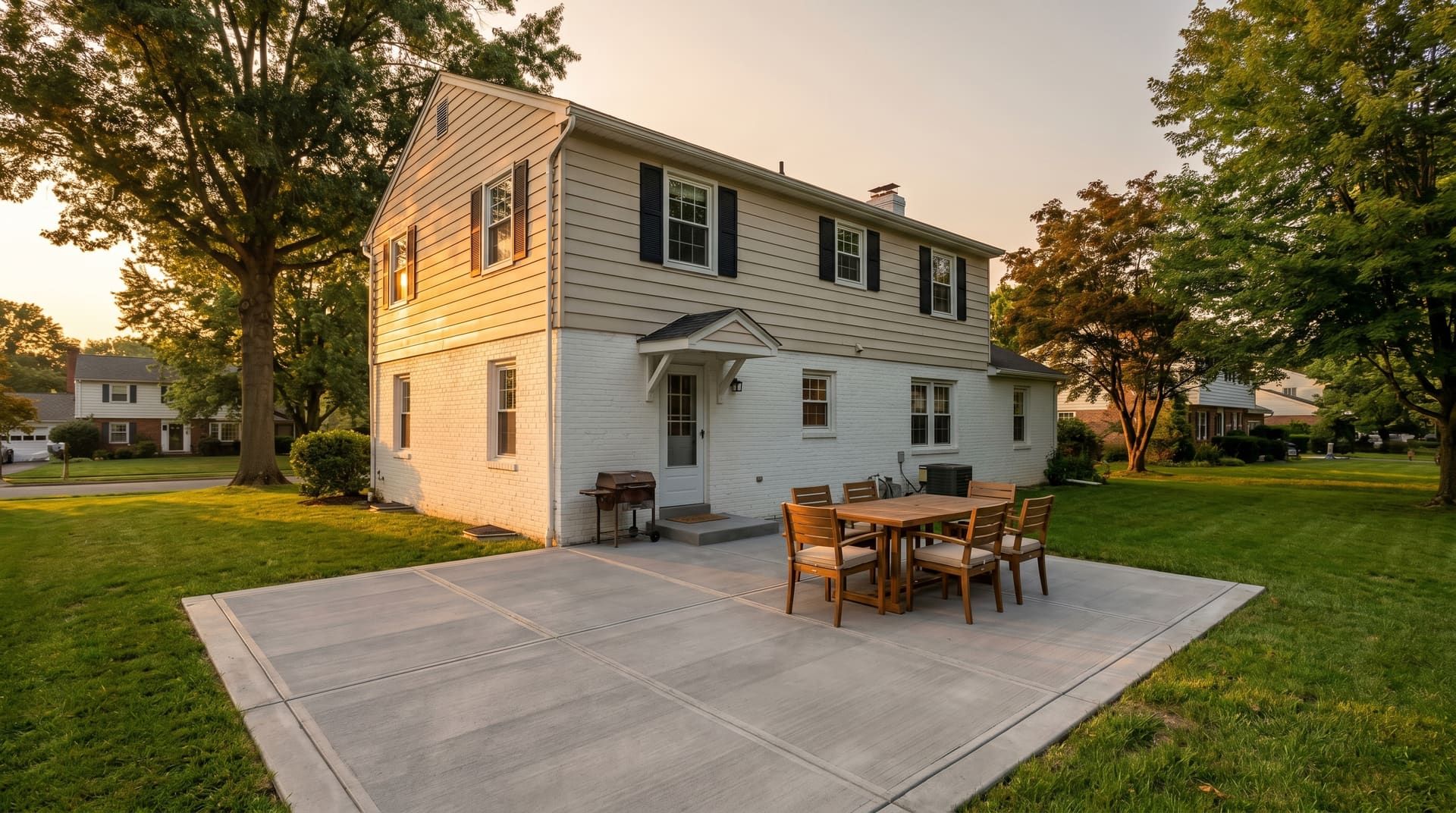
[ Recent project / Plymouth Meeting, PA ]
NextGen Masonry
[ Plymouth Meeting / Vital Stats ]
Population
Land Area
Median Build
Freeze-Thaw
[ Why Plymouth Meeting ]
Plymouth Meeting is an unincorporated community straddling Plymouth Township and Whitemarsh Township in lower Montgomery County, with roughly 7,500 residents in a neighborhood of postwar Colonials, Cape Cods, split-levels, and ranch homes built predominantly from the 1940s through the 1970s. The median construction year sits in the 1965–1975 range, which means the original concrete driveways, patios, stoops, and walkways from those homes are 50 to 60 years old — comfortably past the service life of concrete installed without today's air-entrainment standards.
Upper-middle-income homeowners in Plymouth Meeting invest in their properties. The median household income exceeds $110,000, and median home values are around $586,000. Full tear-out-and-replace projects — not patch jobs — are the norm when a 1960s driveway or patio has reached the end of its practical life. Homeowners here want to know the specification, not just the price.
The jurisdiction question is the first thing to confirm for any Plymouth Meeting project. The community straddles Plymouth Township and Whitemarsh Township — each has its own building department, its own permit fees, and its own construction code official. NextGen Masonry confirms the applicable township for the specific property address on every estimate visit and pulls permits with the correct municipality. Projects on the Plymouth Township side go to Plymouth Township's building department; projects on the Whitemarsh Township side go to Whitemarsh.
Freeze-thaw is the main reason driveways and patios fail in Plymouth Meeting. The community's postwar housing stock was built in an era when plain (non-freeze-resistant) concrete was the norm for residential flatwork. That concrete is freeze-vulnerable — water seeps in, freezes, expands, and cracks the surface apart from the inside. After 50-plus winters, the original slabs are often structurally exhausted. Replacement with 4,000 psi freeze-resistant concrete on a properly compacted base fixes the root cause, not just the symptoms.
Rainwater drainage is a real consideration for new hardscape in Plymouth Meeting. Both Plymouth Township and Whitemarsh Township enforce stormwater rules — adding a new concrete patio or expanding a driveway may trigger a drainage review under township rules. NextGen builds in proper drainage on every project and tells homeowners up front about the hard-surface thresholds that could trigger extra permit requirements.
Common project types in Plymouth Meeting include: full driveway replacement on 1960s properties where the original 4-inch plain concrete has spalled beyond patching; patio additions and replacements behind Colonials and split-levels where the existing slab has heaved from tree root action or frost; concrete walkway replacement from the driveway to a side or rear entry; and retaining walls on hillside lots in Plymouth Valley and Plymouth Meadows where grade changes require managed soil retention.
Tree-root displacement is more common in Plymouth Meeting than the headline freeze-thaw story suggests. The mature oaks, maples, and ashes that line streets in Plymouth Valley and Plymouth Meadows have been growing for sixty-plus years alongside the original 1960s concrete. We assess root proximity at every estimate and design the new pour with root-aware joints, expansion gaps, and (where it makes sense) a thin geofabric layer between subgrade and base — so the next thirty years don't repeat the same lift-and-crack pattern.
"The 1960s-era driveways and patios in Plymouth Meeting were poured before winter-rated concrete was standard. Most of them are due."
[ Field Note / Plymouth Meeting ]
[ Climate Panel / Freeze-Thaw History ]
Why we use a freeze-resistant concrete mix.
Greater Philadelphia averages 25 freeze-thaw cycles per winter. Each cycle drives water into tiny pores in the concrete, where it freezes and expands ~9%. Without 5–7% entrained air, that pressure flakes the surface apart within 5 years. (Severe freeze-thaw zone per building code: ACI F2.)
Philadelphia · cycles per winter
10-yr avg · 25
Freeze-thaw zone
Severe (F2 → F3)
Building-code rating for our climate
Concrete strength
4,500 → 5,000 psi
Higher PSI = denser, more crack-resistant
Entrained air
5–7%
Tiny air pockets act like shock absorbers
[ Common scopes in Plymouth Meeting ]
What we typically pour here.
[ Neighborhoods served ]
5 neighborhoods.
- ·Plymouth Valley
- ·Plymouth Meadows
- ·Cold Point
- ·Whitemarsh Township side
- ·Plymouth Township side
Plymouth Meeting FAQ
Common questions about concrete in Plymouth Meeting.
Q.01
Which township is my Plymouth Meeting property in — Plymouth or Whitemarsh?
Plymouth Meeting straddles Plymouth Township and Whitemarsh Township, and permit requirements differ between them. The quickest way to confirm is to search your address on Montgomery County's GIS portal, which shows municipal boundaries. NextGen Masonry confirms jurisdiction on every Plymouth Meeting estimate visit — we pull permits with the correct municipality from the start, not after an incorrect filing has to be redone.
Q.02
My 1960s driveway is cracked and scaling. Is repair or replacement the better option?
For most 1960s-era driveways in Plymouth Meeting, replacement is the better value. Plain concrete from that era is freeze-vulnerable — it doesn't have the entrained air that modern PA mixes use to survive winter freeze-thaw. Once flaking and cracking have progressed to the point where individual panels are structurally compromised, patching only buys you one to three winters before the neighboring sections follow. Full tear-out and replacement with 4,000 psi freeze-resistant concrete on a 6 in. compacted base gets you a 30-to-40-year life from a clean start.
Q.03
Does Plymouth Meeting require a permit for a new concrete patio?
Both Plymouth Township and Whitemarsh Township enforce Pennsylvania's statewide building code (UCC). New concrete patios with structural elements, retaining walls, or significant new hard-surface area require building permits. For a straightforward patio replacement at the same footprint, permit requirements vary — NextGen confirms requirements with the applicable township building department during the estimate visit before pricing the job.
Q.04
What are typical costs for a new concrete driveway in Plymouth Meeting?
A full driveway tear-out and replacement in Plymouth Meeting typically runs $14–$22 per square foot for standard broom-finish concrete, depending on the existing slab thickness, subgrade conditions encountered during demolition, and access for equipment. Most Plymouth Meeting driveways are two-car width (18–22 feet) with a two-to-three car depth (30–40 feet), putting the typical project in the $8,000–$18,000 range. Every estimate from NextGen is line-itemed so the homeowner can see demolition, base, concrete, and finishing costs separately.
Q.05
Can NextGen build a retaining wall in Plymouth Valley or Plymouth Meadows?
Yes. Hillside lots in Plymouth Valley and Plymouth Meadows frequently require segmental retaining walls to manage grade changes between the house level and the rear yard. NextGen installs Allen Block, Versa-Lok, and comparable segmental systems with proper drainage columns behind the wall face. Walls over 4 feet in height require a building permit from Plymouth Township or Whitemarsh Township (depending on the address), and may require engineered drawings above certain heights. NextGen handles permit research and advises on whether a project falls within standard manufacturer design tables or requires an engineer of record.